

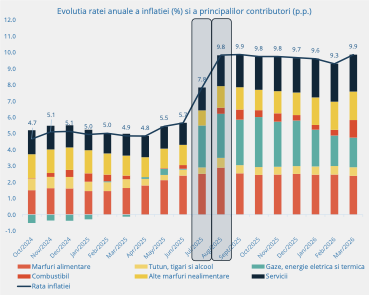
Recent data confirms a shift in dynamics in Romania's economy. After several months of moderation, in March, the annual inflation rate returned to growth, reaching 9.87%, up from 9.31%in February, amid rising fuel prices and a volatile external context, according to the latest analysis by the Concordia Confederation.
This development comes after a 2025 in which significant adjustments, both in energy prices and in the fiscal area, contributed significantly to the current inflation rate.
Under these conditions, price pressures remain high in the short term, even if there are signs of moderation for the second half of the year. Last year's summer brought significant price increases, and when we compare the levels in 2026 to this already expensive period, the annual inflation rate will naturally decrease, even in the absence of actual price reductions.
Consumption slows, the economy feels it.
The rise in inflation is becoming increasingly evident in the economy through the erosion of purchasing power and the deterioration of consumer confidence. Retail sales data indicate a steady contraction, beginning in the second half of last year, with the annual pace of retail sales reaching -6.2%in February 2026, with even sharper declines in the non-food goods segment (-9.4%), a segment that faithfully reflects the degree of uncertainty and pressure felt by households.
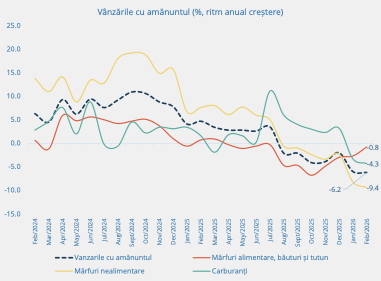
This evolution represents a natural adjustment of consumer behavior: households are prioritizing essential spending and reducing discretionary purchases.
In an economy where private consumption has been the main driver of growth in recent years, such a shift has direct and immediate effects on the pace of economic activity. The probability that the first two quarters of 2026 will register negative real GDP growth is high.
The business environment under multiple pressures
Beyond the impact on consumption, the business environment is undergoing a broader adjustment period. Rising energy and raw material costs are overlapping with persistently high financing costs, and the state's pressure on domestic financial markets has limited the private sector's access to cheaper resources.
Under these conditions, a portion of companies are forced to absorb cost pressures, with visible effects on investment plans and liquidity management. These developments are typical of periods of high inflation, combined with external uncertainty, and indicate an economy undergoing a recalibration process, not a structural crisis.
There are prospects for a comeback, but it's conditional. In the short term, the data temper any optimism. The recovery will depend essentially on three factors: inflation stabilization, the restoration of consumer and business confidence, and the maintenance of a predictable macroeconomic framework.
In the absence of major new external shocks, it is reasonable to anticipate that inflation will enter a downward trajectory in the second half of the year, creating the preconditions for a gradual recovery in consumption and, consequently, economic growth. This recovery will not be immediate, however. Rebuilding trust is a long-term process that cannot be rushed by statements, but only by concrete and consistent actions.
In this context, several directions remain essential:
- Predictability and stability – companies and households need a clear horizon. Prolonged uncertainty regarding the fiscal and regulatory framework amplifies reluctance towards consumption and investment, and must be ended through clear and decisive actions.
- Streamlining public spending – reducing state pressure on domestic financial markets would directly contribute to lowering financing costs for the private sector and free up resources for the real economy.
- Supporting SMEs and attracting investments — these are the segments with the greatest potential for labor absorption and rapid value-added generation during recovery periods.
The relationship between inflation and consumption is becoming increasingly visible in Romania's economic data. After a period of sustained growth driven by domestic demand, the economy is going through an adjustment phase, which is unavoidable in the given context, but not irreversible.
The speed and quality of the recovery will depend on how decision-makers, both public and private, manage to build the conditions for a sustainable resumption of growth.