

In Romania, the sustainable solution is not a large, across-the-board cut in VAT at the pump, but a targeted, temporary reduction triggered only when prices or production costs exceed certain thresholds, according to Dumitru Chisăliță, president of the Intelligent Energy Association (AEI).
”This is because the 2026 budget is already strained, and the targeted deficit is 6.2% of GDP. At the same time, excise tax revenues are very important for the budget, and in the first two months of 2026, revenues from VAT and taxes on energy products increased compared to the previous year. These increases are the main target that must be addressed and returned to consumers,” the analyst claims.
Now, based on the baseline data for the model in Romania, the standard VAT rate is 21% from August 2025, and fuels fall under the standard rate, not a reduced rate. For 2026, excise duties are approximately 3,059.80 lei/1,000 liters for unleaded gasoline and 2,804.29 lei/1,000 liters for diesel fuel. Additionally, theoretically, Romania cannot lower standard excise duties below the EU minimums: 359 euros (1,827 lei) / 1,000 liters for unleaded gasoline and 330 euros (1,679 lei) / 1,000 liters for diesel fuel.
”This means, very practically, that there are only three real and effective tools available to the Government to immediately reduce the general VAT price at the pump, the general excise duty at the pump, or targeted reimbursement/compensation schemes for sensitive sectors and vulnerable groups.
According to the cited source, instrument 3 generally has the best ratio between economic effect and budget cost. Romania already uses this exact logic. For transporters, there's a compensation of 65 bani/liter from January 1st to March 31st, 2026, and 85 bani/liter from April 1st to December 31st, 2026. For agriculture, the state approved a budget of 620 million lei in 2026 for the diesel scheme, and the reimbursement amount is approximately 2.697 lei/liter.
Table 2. Estimated budget cost (Assumptions: annual fuel consumption: 8 billion liters (rounded) and GDP: 2,000 billion lei)
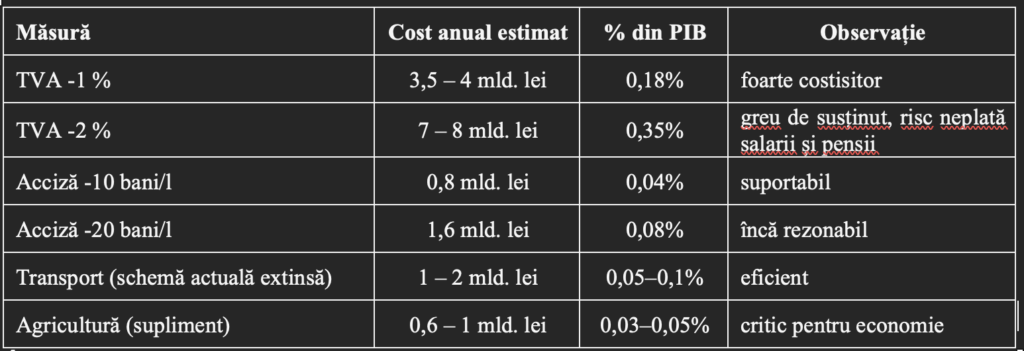
If we have less than 0.1% of GDP, the measure is safe. If it is 0.1–0.2%, the measure is manageable. And if it is >0.3%, there is a risk of inability to pay pensions/salaries.
These measures are insufficient considering the 30%% increase in diesel prices since the beginning of the year.
What can be realistically and prudently reduced?
1) TVA general. Political and fiscal scope is very limited here: 1–2 percentage points, temporarily, and only in situations of severe shock. The reason is simple, VAT cut for all consumers and for all liters sold costs a lot and helps maintain non-essential consumption, not just agriculture, transport, or production. In addition, a VAT reduction from 21% to 19% does not dramatically cheapen the liter, if the reduction is passed on in full, the final decrease is around 1.65% of the gross price. At a price of 10.5 lei/liter, that means 17 pence per liter.
General excise duty. Excise tax has a more direct effect. A reduction of 20 bani per liter the excise duty produces, if transmitted in full and including the VAT effect on top of the excise duty, a price reduction at the pump of approximately 24 cents/liter.
Targeted reimbursements. Here is, in fact, the correct „where.” Not at all the fanfare, but: agriculture, freight transport, public passenger transport, and possibly certain high-fuel-intensity productive activities.
”The advantage is to take the pressure off the areas where fuel enters into the cost of food, logistics, and production, without heavily subsidizing recreational consumption or unproductive urban traffic. Romania already has the administrative infrastructure for this through APIA and ARR,” the analyst claims.
The direct answer to the question „where?”
- Agriculture
Here, any delay or cost increase directly impacts food costs and the agricultural calendar. The current reimbursement scheme must be maintained and paid quickly; if a new price shock occurs, the first extension is justified here. The MADR even maintained the support of 620 million lei for 2026, signaling that the state treats the sector as sensitive.
Table 3. Real economic impact (where it matters)
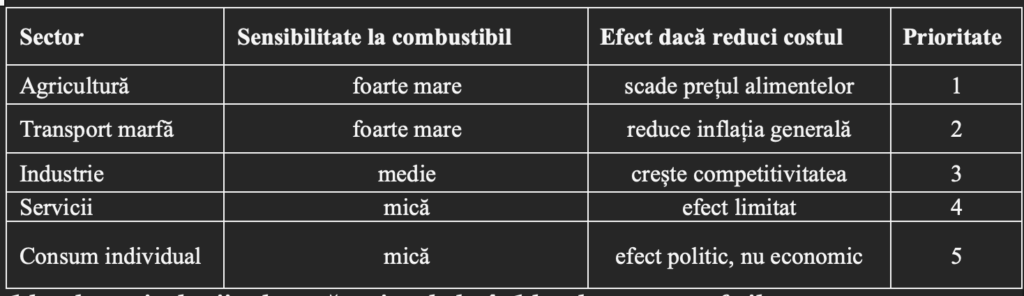
1 leu given to agriculture is worth more than 1 leu given to all drivers.
- Freight transport and public transport
This is the second correct solution, as diesel fuel is passed on in the logistics price, then in the inflation of goods. Romania already has the ARR scheme with 65/85 cents per liter, so the model exists and can be calibrated.
The answer to the question „how much?”
If the goal is Do not affect pensions, salaries, and mandatory payments, it is recommended to use a very strict fiscal threshold, the annual cost of the measure shall not exceed 0.1-0.15% of GDP without a clear sourcing of compensation and 0,2–0,35% din PIB doar dacă există venituri suplimentare certe ori tăieri de alte cheltuieli neesențiale.
With an estimated GDP of around 2.045 trillion lei for 2026, this means approximately:
- 0.1% GDP represents approx. 2.0 billion lei
- 0.15% GDP represents approx. 3.1 billion lei
- 0.2% GDP represents approx. 4.1 billion lei.
Translated into fiscal policy, this means:
- TVA General at most -1%, eventual -2% only for a very short period and only if the budget execution is above plan.
- General excise tax limit 10 – 20 bani per liter temporary.
- Targeted for agriculture and transport, we can go much higher than that, because the eligible volume is much smaller than the total volume sold in the economy, and the economic effect is more concentrated.
The direct answer to the question „when?”
The good model is automatic, temporary, and conditional, with triggers based on diesel fuel price.
The practical model, for Romania
Prudent scenario – over 10.5 lei/l
- THE 21st TVA%;
- Excise duty maintained;
- accelerate reimbursements for agriculture and transport;
- reduced excise duty on 20 bani/L only for eligible sectors;
- Duration: 3 months, with renewal only if indicators remain bad.
Stress scenario – over 11 lei/liter
- 60–90 days -1% TVA and -0.10 lei/l general excise duty;
- in parallel, extended targeted compensation for agriculture and transport;
- Monthly review.
Critical scenario – over 12 lei/l
- 60–90 days -2% TVA and -0.20 lei/l general excise duty.