






Internetul intră într-o etapă similară cu momentul în care motoarele de căutare au devenit principala poartă de acces către informație, arată un nou studiu al Reveal Marketing Research.
While two decades ago users typed in a website address directly, and later started using Google to find information, today more and more people are finding answers through artificial intelligence.
In Romania, the use of these tools is growing rapidly. In the last six months, 77% of Romanians in urban areas have used AI tools, a sign that technology is starting to become part of their daily digital routine.

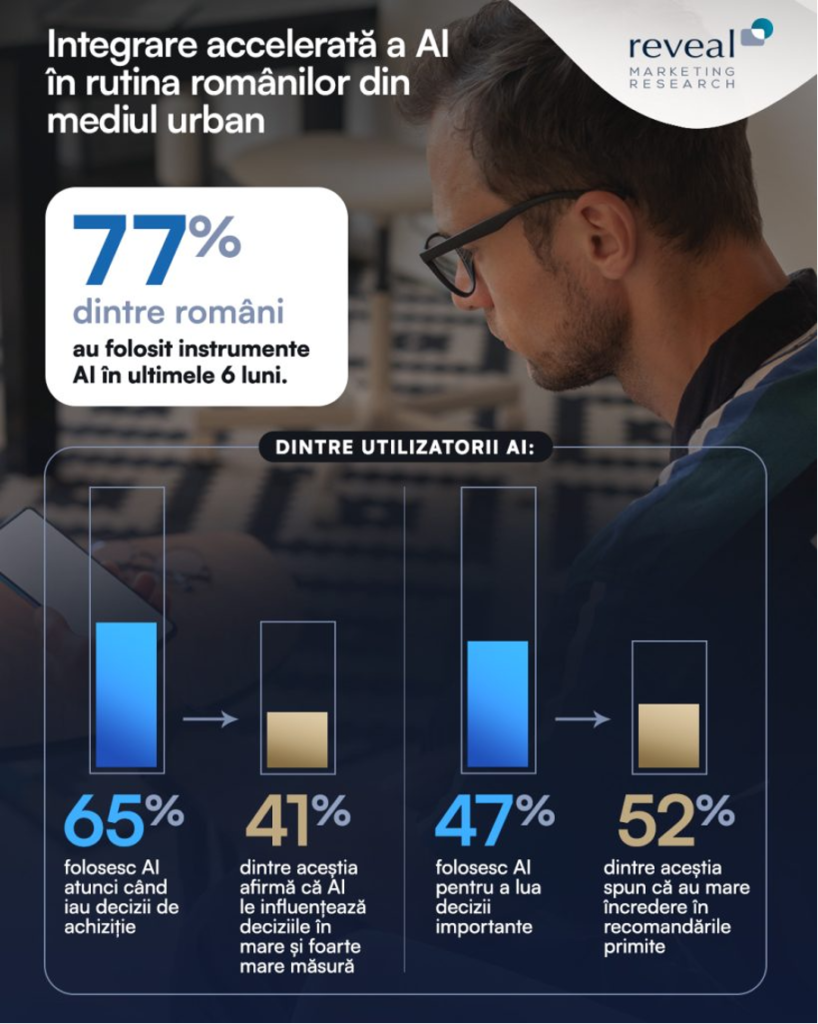
The impact is also increasingly clear in consumer behavior. 66% of AI users say they use these tools when making purchasing decisions, and a significant proportion say the recommendations they receive influence their choice of products or services. At the same time, 411TPTP3T of users say they have turned to AI to make important life decisions, from education or career to major purchases.
In terms of AI-assisted purchase decisions, Romanians are most likely to look for support for electronics and IT (271TP33T), medical services (24%) and courses/education (22%), followed by personal care products (21%), household appliances (21%) and vacations or air tickets (20%).
As artificial intelligence becomes a filter between consumers and online information, a new question for companies is how a brand gets recommended by AI and what kind of information influences these responses.
In the absence of dedicated analysis tools, most current strategies rely on point testing or theoretical interpretations of how AI systems work. However, these approaches provide only a fragmented picture of how AI selects information and constructs recommendations.
In this context, Reveal Marketing Research is launching AI Source Map, a research methodology that analyzes how artificial intelligence systems generate brand recommendations and identifies the sources of information and types of content that influence these responses.
The methodology analyzes real-world interactions between users and AI systems, collecting the responses generated and sources cited to identify the patterns that drive the appearance of brands in AI recommendations. The analysis tracks the ecosystem of sources from which AI builds its responses, and how these differ by user profile and decision context.
Based on this analysis, the AI Source Map provides clear direction on how a brand can increase its likelihood of being recommended: what types of messages are picked up by AI, in which content formats it needs to be present, and in which media it needs to appear in order to become part of the set of sources that systems use to generate responses.
„We are at the beginning of a new phase in the way people discover information online. Just as search engines became the main gateway to the internet two decades ago, artificial intelligence systems are starting to play a similar role today. Brands are no longer just influencing people, but the systems that filter information for them.
”From the studies already implemented, we see that this type of content retrieved and synthesized by AI is significantly more rational and technical, built on clear arguments and criteria, which means that brands need to adapt their communication to become relevant in this new type of information intermediation”, says Marius Luican, General Director Reveal Marketing Research.
The AI Source Map analyzes the online sources that AI systems use most frequently when making recommendations, the types of content that are picked up in responses, and the areas where certain brands are more visible than others. Based on this data, companies can more clearly understand the information environments that influence AI recommendations and how to build their presence in these ecosystems.
As the use of artificial intelligence expands, the way brands are discovered and evaluated is beginning to change. In an environment where more and more consumers are asking AI which products or services to choose, visibility into the answers generated by these systems is becoming a strategic factor for companies, the study's authors conclude.


