





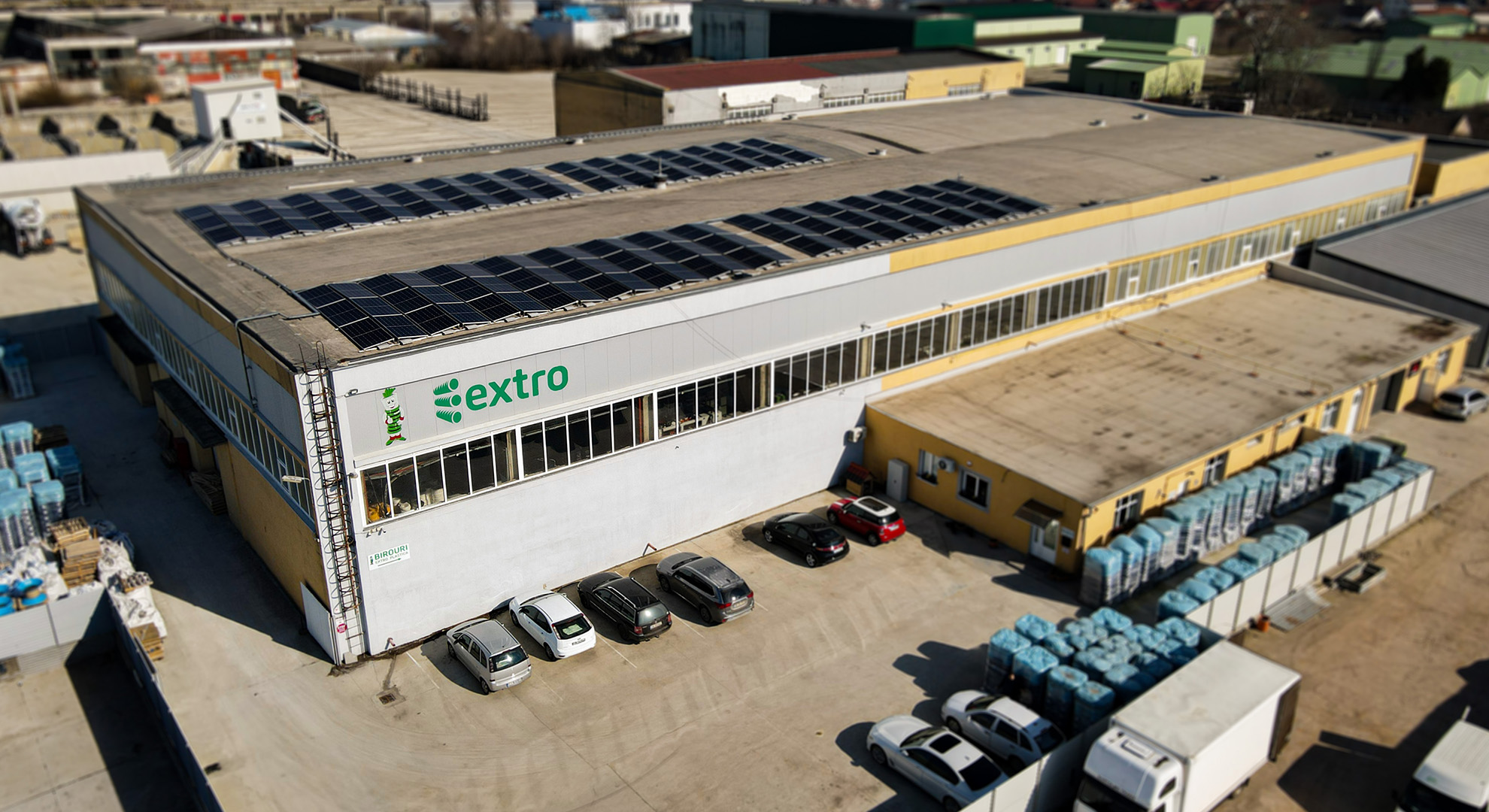
The development of renewable energy projects in Romania is also reflected in the demand for related products, creating a dynamic secondary market that, however, is reactive to the general market context. Alin Stavariu, Commercial Manager at Extroplastica, a Romanian manufacturer of flexible conduits and cable protection accessories, exclusively told Industrynews.ro that beneficiaries of solar projects and EPC companies are increasingly focusing on solutions that offer guaranteed UV resistance, operational safety, and efficient installation, which is reflected in the total long-term cost of the investment. Based on the company's international experience, developed markets emphasize traceability and compliance with standards, while beneficiaries in Romania still place greater pressure on optimizing the initial budget than on minimizing subsequent risks. Extroplastica will be present at the Solar Energy Bucharest Summit, on April 22-23, 2026.
How has the production and demand for Extro Plastica solutions evolved over the last two years, in the context of the acceleration of renewable energy projects and investments in electrical infrastructure?
In the last two years, we've seen a clear increase in interest for our solutions, driven by accelerated investments in photovoltaics and electrical infrastructure. For us, this evolution has translated not only into higher volumes but also into a shift in market mentality: beneficiaries, EPCs, and designers are increasingly focused on sustainability, product performance during operation, and the total long-term cost, not just the initial purchase price.
It is becoming increasingly clear that as projects become larger and more sophisticated, so do the expectations for the materials used. In this dynamic, solutions offering guaranteed UV resistance, operational safety, and efficient installation have begun to be evaluated much more seriously than in the past.
In photovoltaic park projects, how standardized are cable infrastructure solutions today, and where do most adaptations or improvisations typically occur in practice?
În practică, aș spune că există o standardizare parțială, dar nu completă. Sunt deja bine înțelese anumite zone de aplicare – traseele dintre mese, coborârile, intrările în jgheaburi sau zonele îngropate – însă foarte multe detalii se rezolvă încă direct în șantier, în funcție de particularitățile fiecărui proiect.
Most adaptations occur precisely at critical points: at edges, bends, transitions between aerial and buried routes, equipment inlets, or areas where cables are exposed to mechanical stress and weather. This is precisely why we believe the market needs more best practices and solutions designed specifically for these situations, in order to minimize improvisation as much as possible.
What differences do you observe between project requirements in Romania and those in other markets where you operate, particularly regarding material quality and adherence to technical specifications?
The main difference lies in market maturity and how long-term technical risk is assessed. In Romania, there are still situations where certain components in the protection and fastening area are treated as secondary materials, whereas in more mature markets, they are viewed much more clearly as elements that influence the reliability and operating costs of the entire installation.
In more developed markets, the focus shifts more quickly to traceability, compliance with standards, execution predictability, and operational behavior. In Romania, things are evolving in the same direction, but there is still a greater pressure for initial budget optimization than for minimizing subsequent risks.

To what extent does cost pressure influence the purchasing decisions of EPCs, and how is this reflected in the choice of cable protection solutions?
The cost pressure is real and strongly influences purchasing decisions, especially in projects where budgets are very carefully controlled from the bidding phase. In such contexts, there is a temptation to view cable protection solutions solely through the lens of unit price, even though their impact on the total project value is minimal.
The paradox is that seemingly small savings sometimes arise precisely here, but they can generate high operating costs if the chosen solution is not suitable for the actual application in the field. From our point of view, the correct discussion is not about the cheapest product, but about the best combination of safety, installation speed, and total cost of use over the installation's lifespan.
From a manufacturer's perspective, how predictable is demand today? Is there real visibility into projects, or does the market function more reactively, depending on funding and permits?
There is more visibility today than in previous years because the market has a more consistent pipeline of projects and much more active dynamics. However, demand remains only partially predictable because many projects still depend on the pace of funding, authorizations, grid access, and final investment decisions.
For this reason, the market continues to have reactive behavior, with periods of very rapid acceleration. For a manufacturer, this means it's not enough to have a good portfolio; you must also have the capacity to react, stock availability, technical support, and flexibility in your relationship with the EPC and the designer.
What changes do you see in technical requirements with the emergence of more complex projects, such as BESS or hybridization, and how do you respond to these needs in terms of product development?
As more complex projects emerge, such as those with storage or hybrid solutions, the technical requirements become much higher and more specific. It's no longer just about protecting a cable tray, but about integrating solutions that must respond very well to mechanical stresses, outdoor exposure, more rigorous route organization, and the need for predictable maintenance.
Our answer is to develop systems, not just individual products. This means complementary ranges of pipes, accessories, sealing and fastening elements, as well as new products developed based on real problems observed in the field, in dialogue with installers, designers, and photovoltaic park builders.


