


Earnout clauses have been among the most common tools in M&A transactions for some time. They allow buyers and sellers to close deals when they disagree on the immediate price, making part of the purchase price conditional on future performance, says Managing Partner, bpv Grigorescu Ștefanică (Corporate, M&A, Technology)
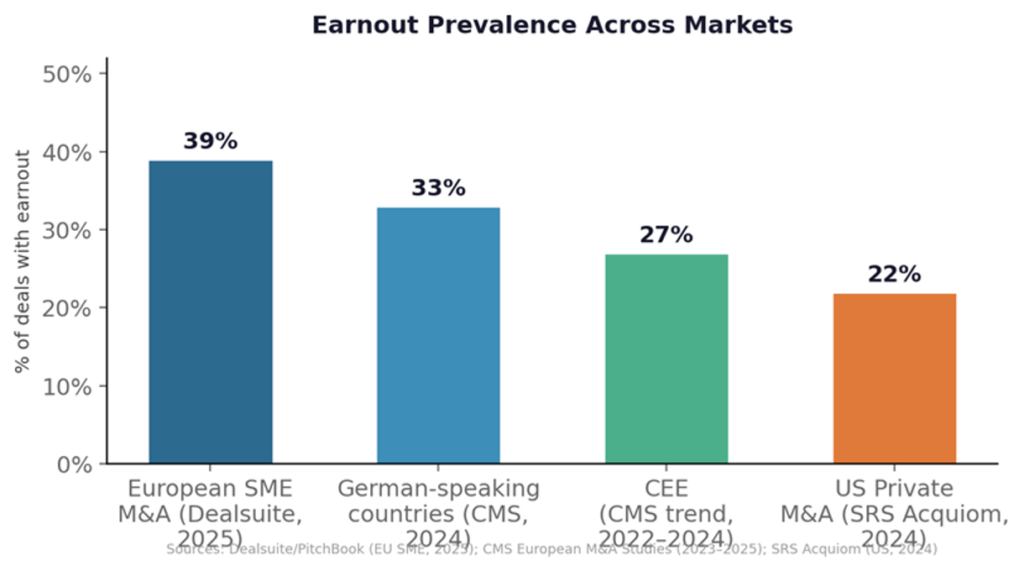
In 2024, about one in five private M&A deals included an earnout. In European SME transactions, the proportion is closer to two in five. Technology deals are particularly prone to earnouts, given the difficulty of valuing companies whose value depends on future growth or products that have not yet reached their full potential.
In this article I wrote about what earnout clauses are, how they work and what a seller should focus on when negotiating such a clause, with an honest acknowledgement of the buyer's position.
1. The valuation difference
If you are selling your company in this or any other market, you will almost certainly hear the word “earnout” at some point. The sooner you understand what it means to you, the better positioned you'll be to negotiate it.
Earnouts are so prevalent today because of the valuation gap. Sellers refer to multiples from the early 2020s when capital was cheaper. Buyers price deals in the reality of 2026, with expensive debt, geopolitical uncertainty and cautious projections. Instead of giving up, both sides defer some of the price disagreement to the future. The seller has a chance to get the full price, provided the deal delivers. The buyer pays less if performance is below expectations. This is an earnout.
2. What earnouts are (and what they are not)
An earnout is a deferred component (deferred) of the purchase price. It is NOT a bonus, retention package or incentive plan. It is an amount that the seller has negotiated as part of the transaction value, which the buyer agrees to pay if certain conditions are met after the deal closes. If you think of the earnout as something in addition to the selling price, you're already leaving money on the table; however, situations where sellers think exactly like this are not uncommon.
The earnout clause in a SPA should cover four things:
- performance indicator,
- earnout period,
- calculation methodology and
- payment mechanism.
Each is negotiable and each carries risks for sellers who don't pay enough attention to them.
Although specific data are difficult to aggregate, some reports suggest that in transactions where a certain level of earnout is reached, typically only about half of the maximum potential earnout amount is paid.
3. How common are earnouts?
The CMS European M&A survey has tracked the presence of earnouts in Europe since 2010, when earnouts appeared in only 14% of transactions. By 2022, this had risen to 271TPTP3T. The 2025 edition of the study, covering transactions from 2024, reports further increases - with earnouts gaining traction particularly in sectors affected by political and regulatory changes, such as energy and technology. In German-speaking countries (Austria, Germany, Switzerland), earnouts have been agreed in almost every third transaction.
Separately, the Dealsuite M&A Deal Deal Terms report, based on data from 959 European law firms covering deals from July 2024 to June 2025, found that 39% of European SME acquisitions included an earnout clause. 42% of M&A advisors reported an increase in the use of earnouts. In more than half of earnout transactions, the deferred portion accounted for 10-201TPTP3T of the total purchase price. The percentages are congruent with the values reported by M&A professionals with transactions in Romania or CEE in general.
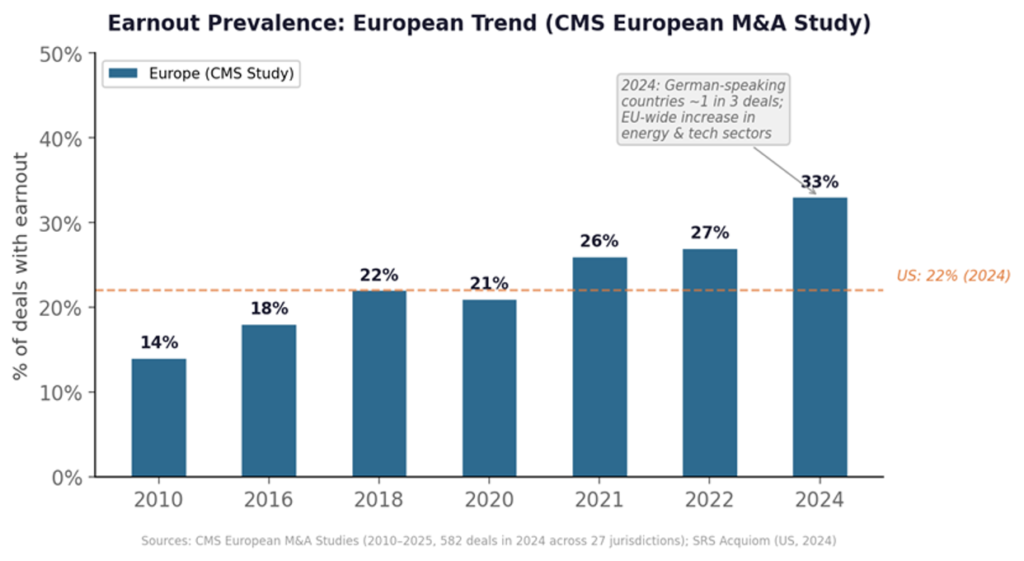
For comparison, US data from SRS Acquiom shows a prevalence of earnouts of around 22% in private transactions in 2024 - down from a peak of 33% in 2023. Globally, S&P Global reports that by October 2025, M&A deals with an earnout component totaled $142 billion - the highest level since 2021.
4. Earnouts in technology transactions
In my experience, most earnouts are found in technology transactions. Tech companies tend to derive most of their value from intangible assets (intellectual property, customer relationships, recurring revenue streams), and their future trajectory is often uncertain. This widens the gap in valuation expectations and increases the likelihood of including earnouts in SPAs. The reports cited confirm that technology is one of the sectors where the use of earnouts has increased the most in recent review periods.
Business solutions SaaS are the most common candidates for transactions with earnout structures. According to market data, approximately 60% of SaaS transactions include some form of earnout, usually tied to revenue or retention targets over a 12 to 24 month period, sometimes even longer. This makes sense, as a SaaS deal is evaluated primarily based on annual recurring revenue (ARR) and net revenue retention (NRR), with ARR being a forward-looking indicator and NRR a measure of historical performance used to predicts the future.
No major study publishes a granular breakdown by sub-sector of the prevalence of earnouts in SaaS, PaaS, e-commerce and AI. But the logic of earnouts applies differently to each. In e-commerce, earnouts tend to be linked to the gross volume of goods or income. In AI, where the value lies in future capabilities, earnouts often include non-financial objectives, such as product integration, technical benchmarks or retaining the engineering team. In the case of infrastructure and platform business, usage-based indicators or customer adoption rates are more frequent.
Important for sellers to remember is that the indicator that defines the earnout should reflect how the business actually creates value. For a company operating a SaaS platform, the earnout should most likely be based on ARR or NRR, not EBITDA, which the buyer can influence by charging costs on your unit. More on EBITDA as an earnout KPI later in this article.
5. Indicators that matter
The choice of performance indicator (the earnout KPI) is probably the most important negotiation point in the whole earnout clause.
In Europe, EBITDA dominates. The CMS study reports that EBIT or EBITDA was used as an earnout measure in 54% of European transactions with earnout provisions. This is consistent with European M&A's wider preference for profitability-based pricing and locked-box structures (used in 62% of European deals), which reduce post-closing working capital adjustments and make EBITDA a more stable benchmark. This is also consistent with what we have observed in our local market. In the US, The focus falls on revenues: 62% of the 2024 earnouts reported the use of revenues as their main indicator, while only 22% used EBITDA (SRS Acquiom).
EBITDA is a more comprehensive measure of business performance, and buyers often prefer it because it reflects profitability, not just revenue growth. But EBITDA is also easily influenced after the deal is finalized. A buyer that charges R&D costs, group-wide overheads or restructuring charges to the income statement of the acquired unit can compress EBITDA without hitting revenue. For the seller, this means that the earnout target becomes more difficult to achieve, without this resulting from the actual trading performance of the business.
We must recognize, however, that there can be legitimate cases for EBITDA-based earnouts, and sellers should understand them. For example, rollup buyers - typically private equity funds running buy-and-build strategies in SaaS - acquire multiple companies to consolidate them into one platform. Their thesis of value creation is margin expansion, not just revenue growth. An EBITDA-based earnout ensures that the vendor is not chasing revenue at any cost, at the cost of eroding the margin profile of the platform. The problem for a vendor is not exactly obvious, but the risk of manipulation is actually higher in a rollup context, because the whole purpose of a rollup is integration - shared services, consolidated sales teams, centralized infrastructure. All this creates ambiguity in cost allocation, which directly affects the standalone EBITDA of the acquired unit. Before accepting an earnout based on EBITDA, In a rollup transaction or otherwise, defined term protections need to be well thought through: isolate the unit's income statement from group-wide cost allocations, lock in the accounting methodology and specify exactly which costs are included and which are excluded from the adjusted EBITDA calculation.
Non-financial KPIs - Customer retention rates, product development targets, regulatory approvals, team retention - are increasingly common, especially in tech deals. They make sense when the acquirer is buying a business for its technology or team, not its current revenue. But they come with their own risks, because KPIs that depend on the buyer's investment decisions (e.g., product development budgets) are only as good as the buyer's commitment to fund them.
Most transactions include multiple indicators. A well-designed multi-KPI earnout could combine a minimum revenue threshold with a customer retention target and a certain level of EBITDA, giving the seller several ways to achieve the deferred price, including the possibility to recover after periods of underperformance.
6. The seller's negotiation guide
As a seller negotiating an earnout, the following points are worth negotiating. None are unreasonable, and all are based on what market practice shows and the types of disputes that arise when earnouts are structured inappropriately.
Be careful with EBITDA and define it precisely
An acquirer is likely to insist on EBITDA (or a share of EBITDA in the KPI basket), so it is important to negotiate a clear definition of Adjusted EBITDA that establishes the pre-closing accounting methodology as the basis and explicitly excludes post-closing cost allocations from group entities. The SPA should specify what is included and excluded from the calculation and require consistency with pre-completion practices.
Negotiate operational protections
This is the most difficult point to win and the one that buyers resist the most. It is a commercial reality that once the transaction is finalized, the buyer controls the company being bought. But the seller's earnout depends on how the buyer conducts the company's business during the earnout period. Market data and experience confirm how little protection buyers are willing to offer sellers.
In most cases, you will find it difficult to negotiate co-management rights with the buyer - no buyer will accept this easily - but you need to define a set of protection clauses in the SPA, which are typically specific operational decisions that require the consent of the seller during the earnout period, such as terminating key commercial contracts, reducing staff directly involved in revenue generation or senior management, changing the pricing model, or reallocating customers or intellectual property to other entities within the group.
Where consent rights cannot be negotiated, sellers should insist on contractual neutralization: the financial effects of certain buyer decisions are excluded from the earnout calculation. If the buyer integrates the target's sales team into its own division, the SPA should provide that any resulting impact on revenues or costs is adjusted and excluded from the calculation or, preferably, the earnout is accelerated. The buyer retains operational flexibility; the seller is not penalized for decisions it did not make.
Management retention, but on your terms
Buyers typically require that senior management remain in place for the duration of the earnout period as a condition of earnout eligibility. This is a protection of the buyer, not a guarantee for the seller, and binds the seller to an organization it no longer controls.
Negotiation should be about what happens when things go wrong. If the buyer fires senior management without cause, the maximum earnout should be accelerated and become enforceable. Without this, the buyer can remove the people best suited to meet earnout targets and then claim that the targets were not met. The SPA should then define the roles, authorities, and reporting lines of senior management during the earnout period in sufficient detail that the buyer cannot empty the position of content.
Vendors should also consider negotiating approval rights over changes in the key team under senior management. If the buyer replaces a sales manager during the earnout period, delivery capability may be lost, regardless of the quality of the replacement as a professional.
Business plan as anchor
If the parties agree on a business plan as part of the transaction, the SPA may refer to it as a baseline for the earnout. Any material deviation, e.g. reducing the marketing budget by a significant percentage, canceling a product launch, may trigger a renegotiation of the targets or an adjustment of the calculation. Less intrusive than consent rights, however, it anchors the earnout in a common set of expectations.
Keep the earnout period as short as possible
Typical earnout periods are 24 months or two full financial years, including the year in which the transaction closes. The longer the period, the more things can change and the more the buyer can influence the outcome. For sellers, the target is 18 to 24 months. Resist any proposal that exceeds this range, especially if there are no partial earnout payments.
Include acceleration clauses
If the buyer sells the company or business unit during the earnout period, the seller should receive the maximum earnout payment. I would argue that the same should apply if the company is merged with the buyer's larger organization.
Protect yourself against compensation
Most transactions I have worked on give the buyer the right to offset contractual claims for breach of representations and warranties or indemnification clauses against future earnout payments - sometimes even before the claim is settled. Sellers should resist or negotiate a threshold and a requirement that only claims finally settled through agreed contractual mechanisms can be offset.
Call for independent dispute resolution
Earnout calculations should be verified by an independent accountant, not immediately settled through court proceedings. The SPA should specify the appointment process, scope, timing and cost allocation. Details matter, for example, an accountant who can only check the figures is less useful than one who can assess whether the buyer's operational decisions have distorted those figures.
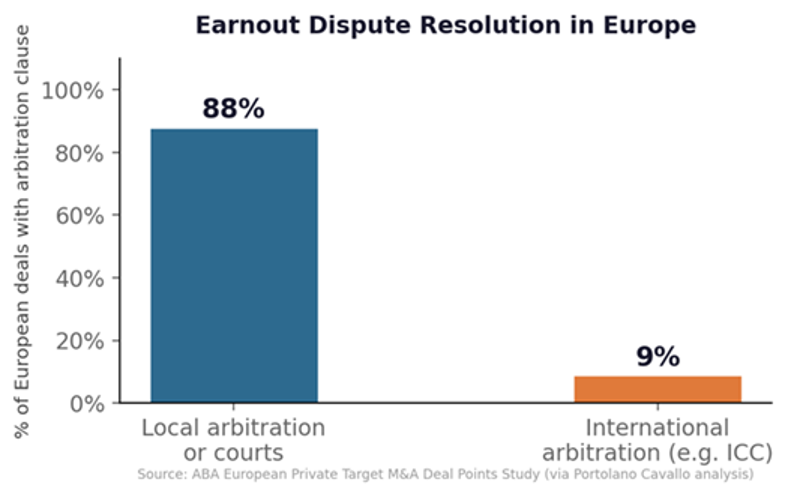
In disputes that go to court, European practice overwhelmingly favors local dispute resolution, with 881TPTP3T of European transactions with an arbitration clause choosing local bodies over international fora such as the ICC. This preference for local fora partly reflects the average market profile of most European earnout transactions, where the costs of international arbitration are disproportionate to the amounts at stake.
Do your due diligence on the buyer
A seller's earnout depends largely on how buyers will operate the business, therefore the seller needs to know how buyers have treated previous purchases. Did they honor the earnouts? How did they accomplish the integration? What happened to the teams? This information is not always easy to get, but it's worth asking for. Most buyers will, in fact, insist that you talk to other sellers in their portfolio, as a trust-building exercise (and perhaps in the hope that you will soften your stance on the other earnout protection clauses).
7. Buyer perspective
Buyers have legitimate reasons for wanting earn-outs. Earnouts allow a buyer to manage valuation uncertainty without walking away from the transaction. When the seller remains to run the company, the buyer wants assurance that the seller is motivated to perform, not just to collect a fixed price [to take into account: serious tax consequences can arise for both the seller and the buyer from an inadequately structured earnout clause, when the seller fails to deliver the earnout KPIs].
Buyers are also concerned that sellers could manipulate the indicators. A seller focused on a 24-month revenue earnout could aggressively invest in short-term sales at the expense of customer quality, relax trade credit to increase today's revenue, or anticipate demand through aggressive marketing. These are real risks, and a reasonable salesperson should recognize them.
With a reasonable buyer at the negotiating table, the strongest negotiating position for a seller is a visibly reasonable one. Sellers who propose earnout adjustments that protect them without limiting the buyer's flexibility demonstrate the commercial sophistication that makes a buyer comfortable investing in the relationship.
8. When earnouts go wrong
A poorly drafted earnout is, in the words of many practitioners, an agreement to go to litigation in the future. Disputes over earnouts are among the most common forms of post-closing litigation in M&A and are increasing in frequency as earnouts become more prevalent.
Let's take a perhaps not exactly hypothetical example: you sell your SaaS company for EUR X million, of which 25% is an earnout based on ARR growth and maintaining a certain level of EBITDA over 24 months. After six months, the buyer integrates your sales team into its commercial division, reassigns your key account managers, packages your product into its platform, and migrates customers from standalone subscriptions to group enterprise contracts unassigned to your ARR. The buyer also charges group IT and other administrative costs to your cost center. When the earnout expires, your ARR has stagnated and EBITDA is nowhere near where the seller expected it to be. The buyer says the conditions have not been met. You think the business would have grown if left alone. The SPA says nothing about either of these situations.
This pattern is commonly repeated in European jurisdictions. The resulting litigation costs are high, the outcomes are unpredictable, and the relationship is destroyed. The lesson is not to avoid earnouts, but to draft them with the specificity imposed by their importance.
Beyond being a price mechanism, earnouts set the framework for the relationship between buyer and seller in the months and years after the deal closes, a period when the balance of power has shifted. The seller no longer controls the company; it is in the hands of the buyer. But the seller's bottom line still depends on what the buyer does with it.
The best earnout clauses are those that both sides can live with, not because they favor one side, but because they are clear, measurable and leave little room for dispute. Selling a company is a pretty big deal, especially for founders, and sellers should invest the time needed to get things right and avoid problems in the future.