
Although the signal given by the Governor of the National Bank of Romania, Mugur Isărescu, is one of major caution, the fall in inflation and the interest rates at which Romania borrows are two clear positive signals for investors. Romania's interest cost on foreign markets has fallen from 8.5% last year to 6.37%, and the NBR is ensuring stability by keeping the key interest rate unchanged, but also by the Governor's assurances that the NBR will continue its policy of moderation.
”We will do the same in 2026. It's not an easy situation. It's a fragile situation. We're walking on pretty thin ice. But we hope to succeed”, said Mugur Isărescu, during the presentation of the Inflation Report.
The rating agencies also want to give Romania a better image, but there need to be better indicators - in any case, the perception has improved since 2025.
„The meeting with Moody's from the Government went very well. It was a meeting as part of the regular visits the agencies make before taking a decision. Moody's will have a decision on Romania on March 6,” said Ștefan Nanu, head of the Treasury Department, who explained that there is a huge difference in the way Romania is currently perceived, compared to the summer of 2025, when, according to the Governor, there were serious capital outflows of around €10 billion.
„At that time, everybody we were talking to - from rating agencies, local investors, foreign investors from different markets, analysts - absolutely everybody was worried. Virtually every measure in every fiscal consolidation package marked a positive moment. And that translates, in terms of financing costs, into very large interest rate cuts,” the Treasury chief was quoted by Hotnews as saying.
Rating agencies have experience with Romania.
”One of our problems has been a lack of consistency. And they want to see things continue. That good things continue into 2026 and they're going to want to see what happens beyond 2026. The negative outlook I don't think will be changed in the first part of the year...As for Romania's interest cost, if we compare with May-June 2025, we have a reduction in lei from levels of 8- 8.5% to levels towards 6.37%. So it means two percentage points down in less than a year. It is a significant reduction,” Stefan Nanu added.
Romania needs investment
Mugur Isărescu says Romania needs to invest and restore aggregate demand.
Too tight a contraction in aggregate demand could produce a ”real recession” and that a strong absorption of EU funds is needed to counterbalance the contractionary effect of fiscal adjustment.
”We have a revival in investment in Q3. The upward trajectory will depend to an increasing extent on financing from external sources, in the context of fiscal consolidation and lower profitability of firms in recent times. Foreign direct investment is interesting, i.e. private investment, with very high growth in 2025. Table on the right - we have the European funds. Here the amounts are very large and they can even help Romania. This is the solution, not elsewhere,” Isărescu said.

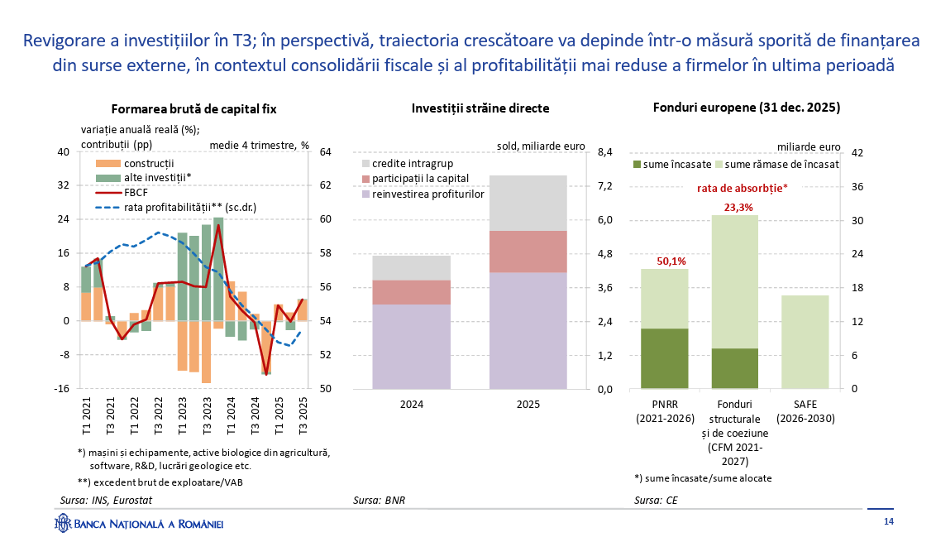
”We kept the policy rate, we didn't tighten it. We haven't even lowered it, because that's what we needed, to send a signal that inflation doesn't matter, right? The central bank can't do that. We take some of the criticism that we read. But we believe that the impact, at least so far, has been positive, in the sense that we have a technical recession, two quarters of GDP decline. Finally, so, let me make a slightly mischievous parenthesis, all over the world GDP is revised, it may come back, and it may come back again in our case, including the December one. But we have avoided annual recession with this guidance. So, in the past year, we still had economic growth, moderate compared to 2024, 0.6% compared to 0.9%, but we avoided recession for the whole year and we hope that with this approach, and based on public investments, they are the only ones that can give economic growth and not give inflation and external imbalances, we will do the same in 2026. It is not an easy situation, it is a fragile situation. Let's say that we are walking on rather thin ice, but we hope to succeed,” Mugur Isărescu said.
”Two clarifications on public investment. In general, if you look at the volume of the figures, consumption is several times higher, the total volume, than investment and even more than public investment. So a compensation cannot be done anyway. An increase in public investment would have to be double-digit, high, in order to compensate for the fall in consumption. Secondly, not all public investment has a multiplier effect. They are seen over a longer period of time. Whereas the fall in consumption is immediately noticeable in the evolution of GDP,” Isărescu added.