

The battery energy storage systems (BESS) market in Romania is approaching a saturation point around 2030, at which point the competition between investors will no longer be about installed capacity, but about the efficiency of projects. According to estimates, total storage capacity could reach around 11 GWh, at which point the pace of new investment could slow and the market would enter a phase of equilibrium.
Currently, investors developing storage battery projects in Romania are looking to returns on equity (equity IRR) of around 18%, but they could fall to around 12% by 2030, as the market matures and arbitrage opportunities shrink.
According to a report by TDP Market Maker - „Blue Paper 2026”, the Romanian energy market is approaching an inflection point: after a period dominated by massive investment in new capacity, the focus is shifting to optimizing returns and the financial structure of projects. The report shows that the period 2026-2030 marks the transition of the energy sector from expansion to execution, in a context in which the market is mature enough to provide relevant historical data for financial modeling, but still offers investment opportunities.
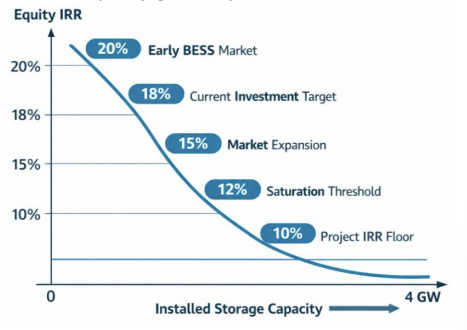
The authors of the study warn that a key moment for the market could be restarting the units at the Cernavodă nuclear power plant at the end of 2029. After this point, the race to the saturation point of the storage market could last less than a year, and the competition between investors will no longer be about installed capacity, but about financial returns on projects (IRR).
The report shows that batteries are becoming essential for balancing the energy system amid accelerating growth in renewable generation. For example, about 16 GWh of storage capacity would be needed to move surplus solar energy from daytime to evening consumption, but only about 11 GWh are considered bankable under current market conditions.
Prices, costs and strategies for investors
The financial model of battery projects is influenced by several factors, including construction and financing costs. According to the report, the estimated price of building storage systems is around €135,000 per MWh, and grid connection costs for stand-alone projects can be as high as 60,000 euro per MW.
Most projects are funded with about 50% debt, at an estimated borrowing cost of around 6%, which directly influences the return expected by investors.
At the same time, the financing model for energy projects is starting to change, as bilateral energy sales contracts (Corporate PPAThese contracts are increasingly signed by large technology or industrial companies and offer producers more stable revenues through standardized contracts and long-term price visibility. The shift from direct spot market exposure to more structured cash flows, combined with lower cost of capital and more available market data, however, creates a limited window of opportunity before investment returns start to compress.
In addition, the market is also starting to change technologically. While many batteries today have an average storage life of around two hours, after 2027, a gradual shift towards four hours, capable of providing greater flexibility to the energy system and more efficiently harnessing the differences between peak and off-peak hours.
What's next for the energy market
The TDP report shows that the energy sector could enter a phase where electricity becomes the basis for new industries. Among the directions analyzed are integrating energy into food production (power-to-food), developing infrastructure for data centers and artificial intelligence (power-to-data) or offshore wind projects in the Black Sea.
At the same time, the energy market will become increasingly competitive as batteries compete for capital with other technologies, including offshore wind projects, gas-fired power plants, new nuclear reactors or synthetic fuel systems.
According to the authors of the report, the evolution of the energy system over the next decade will depend mainly on the economic decisions of investors and on how countries such as Romania manage to integrate into the new industrial chains created by the energy transition.