





Romanians are again being made to pay for a war that is not theirs. The conflict in Iran has become the perfect pretext for a chain of price hikes: gas stations raise prices overnight, retailers inflate price tags and the government watches as tax revenues grow on the backs of citizens, says Dumitru Chisăliță, president of the Intelligent Energy Association.
In an oil-producing country with a unique structure in the EU, designed precisely to stabilize fuel prices and smooth international market fluctuations, Romanians end up paying the eighth most expensive diesel in the EU, about 27% more expensive than Bulgarians (who have the lowest diesel price), says the analyst.
”War is not the real problem, but internal opportunism - a system where every crisis becomes an opportunity for quick profit. When every link in the chain takes advantage of the panic, the bill always goes to the same customer: the ordinary Romanian.”.
Up to 71TPTP3T more expensive products and services in Romania compared to December 2025, exclsuiv due to the increase in the price of diesel. Diesel which is the 8th most expensive in the EU.
In the economy, there are price rises that are immediately visible and price rises that sneak into all prices. Diesel belongs to the second category. It is not just fuel for cars; it is fuel for the whole economy. Trucks carrying bread, machines on building sites, buses in cities and even part of the infrastructure of public services depend directly on it.
The rise in the price of diesel fuel in the first 64 days of the year is having kn knock-on effects that, while individually small, are spreading to almost all sectors of the economy.
In the study conducted by the Intelligent Energy Association - Analysis of oil flows, costs and pump prices in Romania - we have made an estimate of the effect of the increase in the price of diesel fuel in the first 64 days of the year compared to December 2025. This estimate is reproduced below (the increase in diesel fuel in the period December 31, 2025 - March 5, 2026 being 14%).

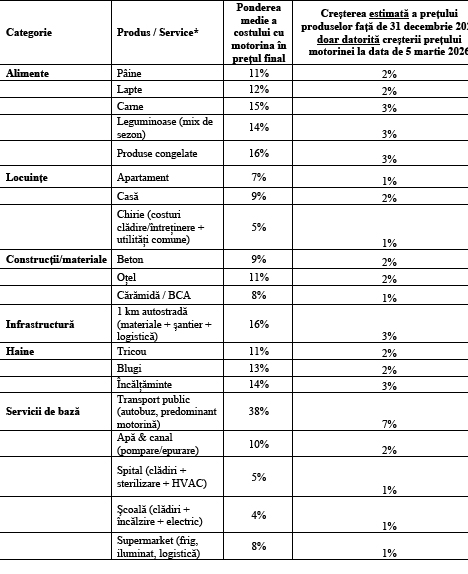
In the food area, the impact is immediate. Grain transportation, product distribution and warehouse logistics are heavily dependent on diesel. Thus, bread and milk are estimated to grow by around 2% compared to December 2025 from this factor alone. For meat, pulses or frozen products, where the logistics chain is more complex and involves refrigerated transportation, the impact amounts to about 3%.
Housing is not immune to the fuel effect either. Building materials are transported almost exclusively by truck, and construction machinery runs largely on diesel. Under these conditions, the cost of a new flat is rising by about 1% and that of a house by about 2%, solely because of the rise in diesel prices. Even the rent indirectly reflects these costs, with an estimated increase of around 1%, through maintenance, logistics and ancillary services.
The building materials sector is feeling the same effect. Concrete and steel are getting more expensive by around 2%, while bricks or BCA are going up by around 1%. Transportation of raw materials, machinery operation and industrial logistics are all dependent on fuel.
The impact becomes even more visible in infrastructure. Building one kilometer of highway involves hundreds of trucks, excavators, bulldozers and heavy machinery. Under these conditions, the cost of a kilometer of highway increases by about 3% just because of diesel.
The textile industry is not immune either. The transportation of raw materials, production and international distribution are contributing to estimated price increases of around 21TPTP3T for T-shirts and jeans and around 31TPTP3T for footwear.
But the greatest pressure is in basic services. Public transport, where buses run predominantly on diesel and see an increase of around 7%. Other essential services - such as water and sewage - increase by about 2%, as pumping and logistical operations depend indirectly on energy and transport costs.
Public institutions are more moderately affected. The operating costs of hospitals and schools increase by about 1%, and the operation of supermarkets - where logistics and supply chain play a major role - adds about 1% to prices.
The fact that Romania has reached 8th place in the European Union for the price of diesel fuel should be a wake-up call, not just a statistic of the moment. Diesel is not just any old product - it is the fuel that drives agriculture, transportation, construction and, by extension, the real economy.

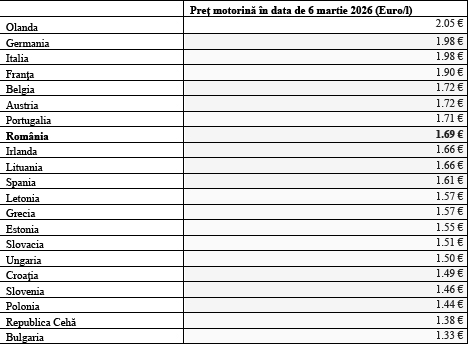
Huge differences from the neighbors. In Romania the price of diesel is 1,69 €/l diesel in Bulgaria is 1,33 €/l, i.e. the difference is 27%. România al doilea cel mai mare producător de țiței, cu cea mai complexă structură petrolieră din Europa și are o motorină mai scumpă ca în Bulgaria!!!
Individually, these percentages seem small. But the economy works by adding up. When almost every sector adds a few percent for the same reason, the end result is a constant pressure on the cost of living.
Diesel does not appear on the label of products in the store. But it is present every step of the way to the shelf. And when its price rises, the whole economy moves a little more expensively, concludes the AEI analysis.


