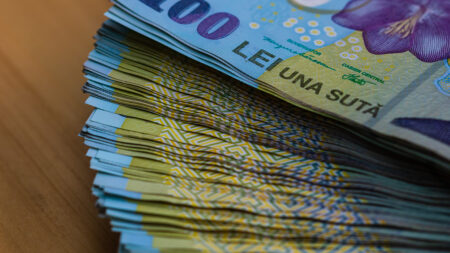




A weak leu and rising interest rates on international markets from which Romania borrows – these are the main consequences of the political crisis triggered by the PSD. The stock market also lost on most indices last week and opened lower on Monday, but recovered somewhat during the day.
Thus, on Monday, one euro exceeded 5.21 lei in interbank market transactions. And although the exchange rate has since stabilized at a level close to 5.20 lei, the national currency remains vulnerable due to the political uncertainties triggered at the end of April, reaching a historic mark at the NBR of 5.19 lei per euro. Analysts, however, warn of false alarms in the market, given that some voices are projecting the exchange rate to implausible values, such as 7 lei per euro. Such alarms are not real and are not based on context, analysts say.
Analysts say that once it has risen, the exchange rate is likely to stabilize at a lower level, but will never again reach the pre-crisis threshold. Yields on the international market for Romania’s 10-year bonds also rose to 7.401% (on Monday afternoon, the yield stood at 7.371%), though they remain 0.51% below the previous annual level.
Inflation generated by the Gulf War is descending upon everything.
La începutul lunii mai 2026, prețurile la carburanți în București au înregistrat noi scumpiri, motorina apropiindu-se de pragul de 10 lei pe litru, iar benzina depășind în unele locuri 9 lei. Luni, 4 mai prețurile minime în București pentru benzină sunt de aproximativ 8,92 lei/litru. În stațiile OMV, benzina a depășit 9 lei, ajungând la 9,02 lei/litru. Iar prețurile la motorina standard sunt foarte ridicate, ajungând la aproximativ 9,67 – 9,8 lei/litru.
Meanwhile, the Bucharest Stock Exchange (BVB) also opened lower across most indices on Monday, with total trading volume reaching 11.4 million lei (2.2 million euros) 30 minutes after the market opened. The main BET index, which tracks the performance of the 20 most liquid companies, recorded a decline of 0.50%, while the BET-Plus index, which tracks the performance of the 43 most liquid stocks on the BVB, recorded a decline of 0.51%. Later, around 3:00 p.m., both indices gained 0.20%.
”Volatilitatea probabil va rămâne, fie într-o parte, fie în alta. Vom avea probabil mișcări mai mari. În perioada următoare, suntem într-o criză politică, incertitudinea e ridicată și automat când incertitudinea e ridicată, cea mai bună, să zicem, metodă de a ne proteja activele e prudența. Cursul euro-leu se duce, la un moment dat, către fundamentele economice. Deci fundamentele vor determina ce se va întâmpla, să zicem, pe un termen mediu. Vedem că România are două deficite mari – cel de cont curent și cel bugetar. Ele sunt nesustenabile și agențiile de rating spun acest fapt și, iarăși, că valorile lor ridicate ne scot din categoria țărilor recomandate investițiilor, dar ceea ce ne ține este apartenența la Uniunea Europeană, și anume fondurile europene” , says Financial Analyst Adrian Codirlașu, president of CFA Romania, for RRA.".
Adrian Codirlasu points out that investors are attentive to any sign that the absorption of these funds might be delayed or insufficient, and their concern is quickly reflected in the exchange rate and the state's financing costs.
Otherwise, Romania is already borrowing at some of the highest interest rates in the European Union, and pressures on the leu are also fueled by this context. The analyst also explains that previous experiences show that, during periods of political instability, the exchange rate can depreciate rapidly, but only partially recovers after the situation is resolved, without reaching previous levels.