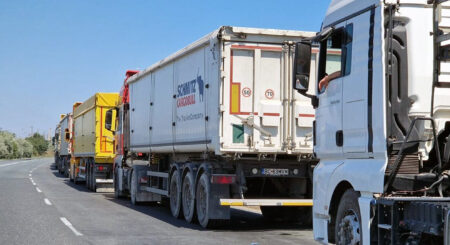
Rail efficiency is being ignored while the energy crisis deepens, believes entrepreneur Gruia Stoica, president and founder of the GRAMPET rail group, who also states, in a transmitted material StartupCafe.ro, that the train remains underutilized and underfunded, while public policies continue to favor road transport, which is more polluting and more expensive.
Amidst the global energy crisis, when supply security and resource efficiency should be strategic priorities, Romania continues to ignore one of the most obvious solutions at its disposal: rail transport. Recognized at the European level as the most energy-efficient form of land transport, trains remain underutilized and underfunded.
This discrepancy between rhetoric and reality is no longer just a strategic problem, but has direct effects on the economy, environment, and national infrastructure.
„It is a major contradiction for the authorities to invoke energy conservation and, at the same time, to favor transportation that consumes the most diesel. Real reduction of energy pressure is not made through declarations, but through decisions: moving heavy goods by rail and eliminating incentives that push logistics flows, unnecessarily, onto roads.”," declares Gruia Stoica, president and founder of GRAMPET Group.
Freight rail transport is, by definition, a model of efficiency: a single train can replace 30 to 50 trucks. In terms of consumption per ton-kilometer, a train uses up to ten times less diesel fuel than road transport for the same amount of cargo transported. Although Romania should aim to reduce pressure on fossil fuel consumption, the reality on the ground indicates the opposite direction, where the structural energy advantage of railways continues to be systematically ignored.
Road transport remains favored in Romania because the state collects more fiscally, according to Stoica. This high fuel consumption brings the authorities larger revenues from excise duties and VAT, turning resource waste into a budgetary argument that is difficult to ignore, but detrimental in the long run. In this context, rail transport could handle large volumes of goods with much lower fuel consumption, but supporting it is not a priority for the Romanian Government. This fact is demonstrated by the constant decline in volumes transported by rail, from almost 220 million tons after the Revolution to only 43 million tons in 2024, while road transport has increased to over 320 million tons per year.
„Trăim într-o eră a consumului accelerat, în care volumele transportate – de la materii prime la alimente și piese industriale – sunt într-o creștere continuă. În acest context, Guvernul României nu poate continua să favorizeze un tip de transport doar pentru că încasează sume mai mari de pe urma acestuia, o situație care oricum este rezultatul unui sistem de taxare dezechilibrat. Într-o Europă care recunoaște calea ferată drept cea mai verde formă de transport terestru, nu ne putem tăia singuri șansele de aliniere la standardele europene din pur oportunism fiscal”emphasizes Gruia Stoica.
Authorities cannot promote sustainability while continuing to favor road transport, responsible for 70% of greenhouse gas emissions, over rail transport, which generates only 0.4% of these emissions in the European Union. If there is a genuine desire to reduce pressure on the fuel market, it is imperative to shift heavy goods to rail, avoiding the unnecessary pushing of logistical flows onto an already congested road infrastructure.
The development of intermodality brings undeniable advantages by drastically reducing total energy consumption and diminishing strategic dependence on diesel, while also offering the necessary stability for supply chains during periods of global instability.
Reintroducing rail transport to the center of the logistics chain, through intermodal solutions, is becoming a pragmatic economic decision that goes beyond ecological objectives, serving as a direct tool for increasing the competitiveness of national industry. The implementation of this sustainable model guarantees less congested and degraded national roads, which automatically translates into a reduction in the number of road accidents and a decrease in public costs for infrastructure maintenance. A strong railway network protects the national budget, transforming each ton transferred from road to rail into real savings for all taxpayers, according to the entrepreneur.