
In an inflationary environment, non-invested savings are not neutral, but constantly depreciating. The purchasing power of money declines and postponing financial decisions means, in real terms, a loss of capital.
As I have always argued in my analyses for economic publications, the housing market should not be viewed through the prism of fear, but of mathematical opportunity. In January 2026, we are at a unique point: we have wages almost double what they were in 2019, but access to lower interest rates than then. Keeping money „in the mattress” in a high inflation environment is the surest way to lose capital. Money needs to circulate. Investing in a refinance that lowers your rate and frees up monthly liquidity is the healthiest form of financial hygiene. Basically, you're using the banking context to protect your work
says Claudiu Trandafir, economist and founder of OferteBancare.ro.

Higher wages, lower interest rates, reduced financial effort
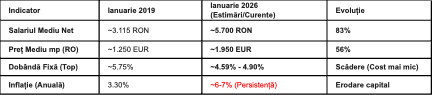
Benchmarking 2019-2026 shows a reality that is hard to ignore. Average take-home pay has nearly doubled since 2019, while fixed interest rates available today are below levels considered „good” seven years ago. Even though prices per square foot have risen, the monthly effort to pay an installment relative to income is lower today, and access to credit is more mathematically efficient.
Mirror analysis: 2019 vs. 2026 (NIRB/INS data)
According to statistics, the ratio between income and housing costs has improved significantly over the last 7 years:
- Salaries: the average net salary has increased by more than 80% (from ~3,100 RON in January 2019 to more than 5,700 RON today).
- Dobânzi: În ianuarie 2019, o dobândă fixă „bună” era de 5.7% – 6%. Astăzi, băncile se bat în oferte de refinanțare cu dobânzi fixe ce pornesc de la 4.59%.
- Real Estate: Although the price per square meter has increased (national average from ~1.250€ to ~1.950€), the financial effort to pay the installment relative to the average salary is lower in 2026.

In both 2019 and 2026, the economic environment is marked by internal and external risks, but experience shows that periods of uncertainty can create opportunities for those who act strategically.
In 2019, domestic regulatory instability, the transition from ROBOR to IRCC and political tensions were superimposed on an international context dominated by the US-China trade war, Brexit and the slowing European economy.
In 2026, the main threats are inflation, eroding passive economies, and a tense external context characterized by regional conflicts, geopolitical instability and the reconfiguration of energy markets, with a direct impact on costs and economic decisions.
Refinancing - shield against inflation
For Romanians with loans taken out in recent years, refinancing is becoming one of the most effective forms of „financial hygiene”. Moving a high variable-rate loan to a lower fixed rate can generate monthly savings of 900-1,000 lei, money that would otherwise be lost to inflation.

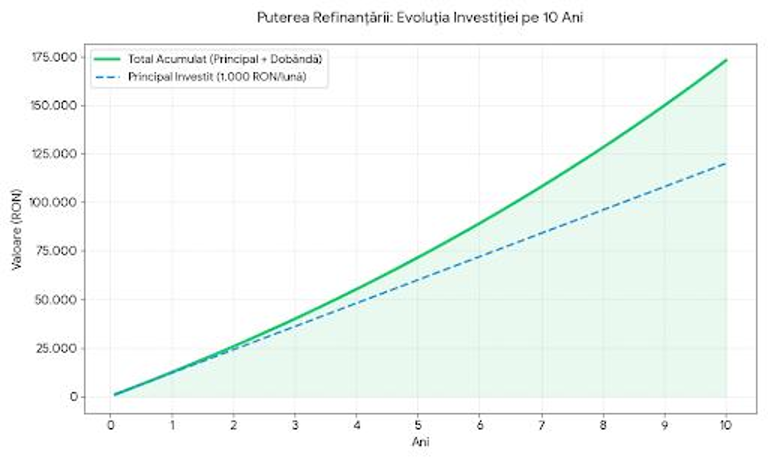
„In inflationary times, financial decisions are no longer about courage or fear, but about sound calculations. In 2026, the banking environment allows for cost optimization through refinancing and smart loan repositioning. Those who analyze their data and act in an informed way can protect their capital even in a tense economic environment”adds Claudiu Trandafir.