





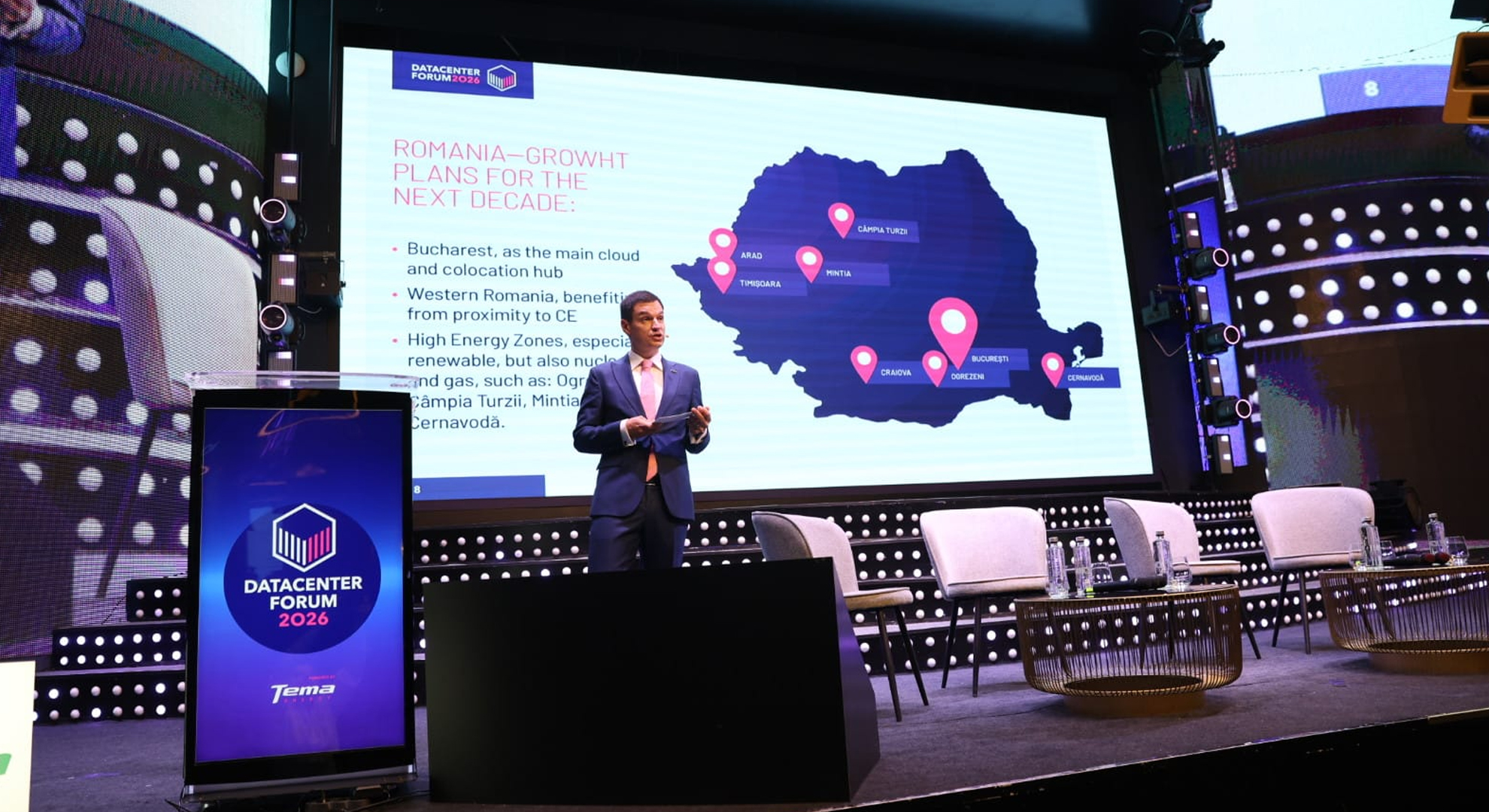
Experts say Romania has a window of opportunity of about 12 months to attract significant investment in AI and hyperscale data centers. Europe does not have enough energy immediately available for AI Factory projects, and in Romania, data centers account for only 0.21% of total electricity consumption.
Thus, the future of data centers is no longer defined by construction capacity, but by quick and predictable access to energy, according to analysts present at DataCenter Forum Romania.
In a European market increasingly constrained by an electricity power deficit, Romania has the opportunity to become the next strategic frontier for artificial intelligence (AI) infrastructure, similar to Norway. The Nordic country, despite its relatively modest presence on the European data center map in the past, has attracted global attention through the development of major projects like Stargate Narvik – an AI hyperscale initiative in Northern Norway, supported by advanced technology ecosystems and hydropower. The project aims for a capacity of over 230 MW of renewable energy, intended to host approximately 100,000 NVIDIA GPUs for advanced artificial intelligence tasks.
Pe acest model de accelerare bruscă a poziționării într-o piață AI globală, România ar putea urma un parcurs similar printr-un prim proiect de peste 100 de MW, cu potențialul de a funcționa ca un catalizator pentru investiții hyperscale și infrastructură AI în regiune.
Thus, the main lesson of the forum is clear: in the AI economy, countries that manage to quickly transform available energy into digital capacity become the new power centers of Europe.
From „Speed to Market” to „Speed to Power”
While mature markets in Western Europe (FLAP region) face grid connection delays of up to 5-7 years, Romania is in a privileged position, capable of offering immediate solutions. Mihai Manole, CEO of Tema Energy: „Today, in the development of the Data Center market, the key element is Speed to Power. Investors come where energy is already available and where connection time is minimal. Romania has energy hubs, especially in the west and center of the country, where it can provide up to 500 MW almost immediately. This is our ‘ticket’ to attract Hyperscale projects.”
AI Rewrites Industry Rules: Global Leaders' Perspectives
The transition to „AI Factories” industrial facilities is completely changing the consumption profile, infrastructure, and geopolitical stakes of data centers, according to analysts.
Rod Evans, Vice President for Supercomputing, Cloud, and AI at NVIDIA, states that the demands of next-generation technologies are exponentially increasing per-rack power consumption, making liquid cooling an absolute necessity, not an option. He also warned about the importance of digital sovereignty, emphasizing that countries must become AI infrastructure producers, not just consumers, to protect their own data and national culture.
And Jonathan Berney, founder of Accelerated Infrastructure Capital (AIC), states that Western Europe is facing an energy bottleneck, lacking the energy necessary for new AI projects. He pointed out that Romania has a critical window of opportunity, of approximately 12 months, during which it can leverage its energy abundance to attract global clients, mentioning the ClusterPower project in Craiova as an example of an „anchor” investment already prepared for AI.
Romania's strategic assets
Currently, data centers account for only 0.21% of Romania’s national energy consumption, compared to 61% in the Netherlands or 241% in Ireland, leaving enormous room for growth. Among the strengths that can transform the local market into a „Hyperscale” destination are uncongested grid areas and hundreds of megawatts accessible through rapid connection agreements, realistic implementation timelines, with projects able to become operational in 18–20 months, a diversified energy mix, strongly supported by renewable projects and storage solutions, and human capital, as Romanian engineers are already a key force in the operation of major European hubs.


